Natural England approves Hoylake Beach Management Plan

Agreement has been reached on a plan that will allow for the clearance of some vegetation on Hoylake beach.
The amount of vegetation that can be removed is at a level that is sufficient for the safe, ongoing operation of the RNLI lifeboats but which will not cause significant damage to the environmentally protected area.
Natural England has written to Wirral Council to give conditional assent to the revised Beach Management Plan that was submitted by the council in November alongside a detailed Habitat Regulations Assessment (HRA) conducted by specialist advisors, Royal HaskoningDHV.
The agreed plan will begin on 1st March 2026 and sets out how Hoylake beach will be managed for the next five years to 31st March 2031, while also committing to measures that will contribute to the effective management of the coastline for the next 50 years.
The council is now planning for the clearance work to start in March and will follow Natural England’s instruction to minimise impact on local habitats, including natterjack toads. Slipways and beach access points will also be cleared as part of the operation.
This has been a long time coming and I’m really pleased with the progress we’ve made to get here. Hoylake beach is such a special place for so many people and reaching this point truly matters.
We now have a clear plan, and real certainty, about how the beach will be managed in the months and years ahead. It gives the RNLI the reassurance they need to continue their lifesaving work from the Hoylake station, while also protecting the natural environment that makes this stretch of our coastline so special.
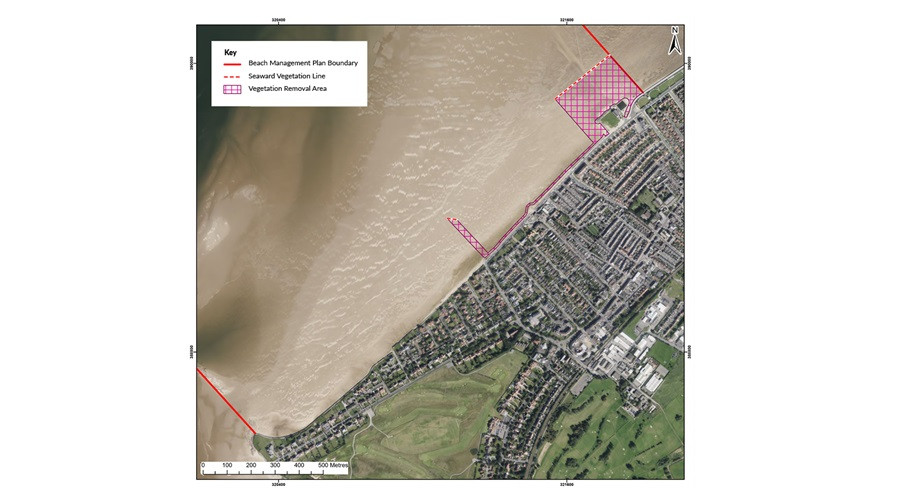
Under the plan, around 1.55ha of saltmarsh vegetation would be removed between King’s Gap and the RNLI station, as required by the RNLI. This includes from an area around the Hoylake RNLI station itself, extending 75m west and 100m to the east, and out towards the sea.
It also includes the clearance of a 7.5m wide strip from the Hoylake RNLI Station – which includes the 75m described above - to King’s Gap, a 26m wide strip from King’s Gap extending seawards and a 7.5m strip connecting the Alderley and Trinity Road slipways.
The location of the vegetation free strip has been planned to avoid embryonic dune habitat and shore dock plants.
The work to remove the vegetation will take place over a single period of time lasting no more than four weeks, between April and September, with a maximum of three operations per week. It will be done using mechanical methods.
This has been a complicated and painstaking process, involving a number of partners and a range of individual and collective viewpoints. It was never going to be easy to find a position that could be assented by Natural England and would please all sides in this long running debate.
With the clarity provided by this decision, we can move forward, managing the beach in everyone’s interests and carefully monitoring the results of any actions taken. We will carry out the work to prepare the beach, starting in early March 2026, with the utmost caution and following Natural England’s instructions.
My hope is that all interested parties will see the value of what has been achieved through this process and come to love this beautiful beach.
Hoylake Beach is a designated Site of Special Scientific Interest (SSSI). This means it is protected under law from anything that could damage the special interest of the site, including actions that could cause harm or disruption to the range of rare or nationally important species and habitats.
Hoylake is special for its intertidal sands and mudflats and as a feeding and roosting site for waders and wildfowl. It is also a Special Area of Conservation, Special Protection Area and Ramsar site.
Natural England is the government’s statutory nature conservation adviser and is responsible for enforcing laws that protect wildlife and the natural environment. In order for the proposed management plan to be carried out legally, the council had to gain assent from Natural England.
Additionally, both Wirral Council and Natural England have statutory duties to protect biodiversity whilst conserving and enhancing the landscape and to further the conservation and enhancement of Sites of Special Scientific Interest.
In the letter to Wirral Council confirming its assent to the Beach Management Plan, Natural England said a key consideration was the council’s commitment to producing a long-term management plan that includes all coastal sites for which it is responsible, including those – such as West Kirby – which already has assent for beach management.
Natural England’s letter stated: "Natural England has considered your proposals and the need for vegetation removal in line with the RNLI’s operational requirements for life-saving operations only. Natural England is satisfied that you have provided Natural England with further evidence to support the RNLI requirements as per our previous requests.
"Natural England therefore considers that allowing access for the RNLI to carry out their lifesaving operations by the careful management of the SSSI (removing vegetation) would be in line with NE’s purpose of contributing to social well-being, by ensuring the RNLI can help to protect the public when they are engaging in open-air recreation at sea.”
The amount of habitat to be lost by the clearance is estimated at approximately 5.2 hectares, equating to a 0.3% loss across the Dee Estuary SAC (including West Kirby). This loss at SSSI level equates to 12.6%.
The letter added: “Whilst this loss is appreciable, the whole SSSI has gained 41.29 hectares of saltmarsh since management paused in 2019 (Natural England Condition Assessment, 2024).
“Even with the appreciable loss, we consider there is still an overall gain in saltmarsh habitat and with a further commitment to no management zones included in a holistic beach management plan, we would be satisfied this loss would not result in significant damage to the protected features of the SSSI or constitute an adverse effect on the integrity of the SAC either alone or in combination with other plans or projects."